
My Physics Research
Welcome to my physics research page! Here I talk about my research interests and describe some projects I have worked. At the bottom of the page you will find a list of publications I am an author on and talks I have given on these topics including links where you can watch some of them! If you would like to know about any of the topics discussed here feel free to send me an e-mail because I always enjoy talking about them.
Research Interests
The shortest description I have of my research is that I study particles in space. More broadly, I try and use observations of space to better understand the fundamental building blocks of the Universe and the laws that govern them. During my PhD I have specifically been studying the impact different dark matter models have on astrophysical processes. This has resulted in a paper where I, along with a group of collaborators studied the observational signatures that would be created by primordial black holes in theories with additional dimensions. My masters research focused on determining the details of bubble growth during a strong electroweak phase transition in the early universe which is important for understnading whether that phase transition is able to provide an explanation for the observed matter - anti-matter asymmetry.
Extra Dimension Black Holes as Dark Matter
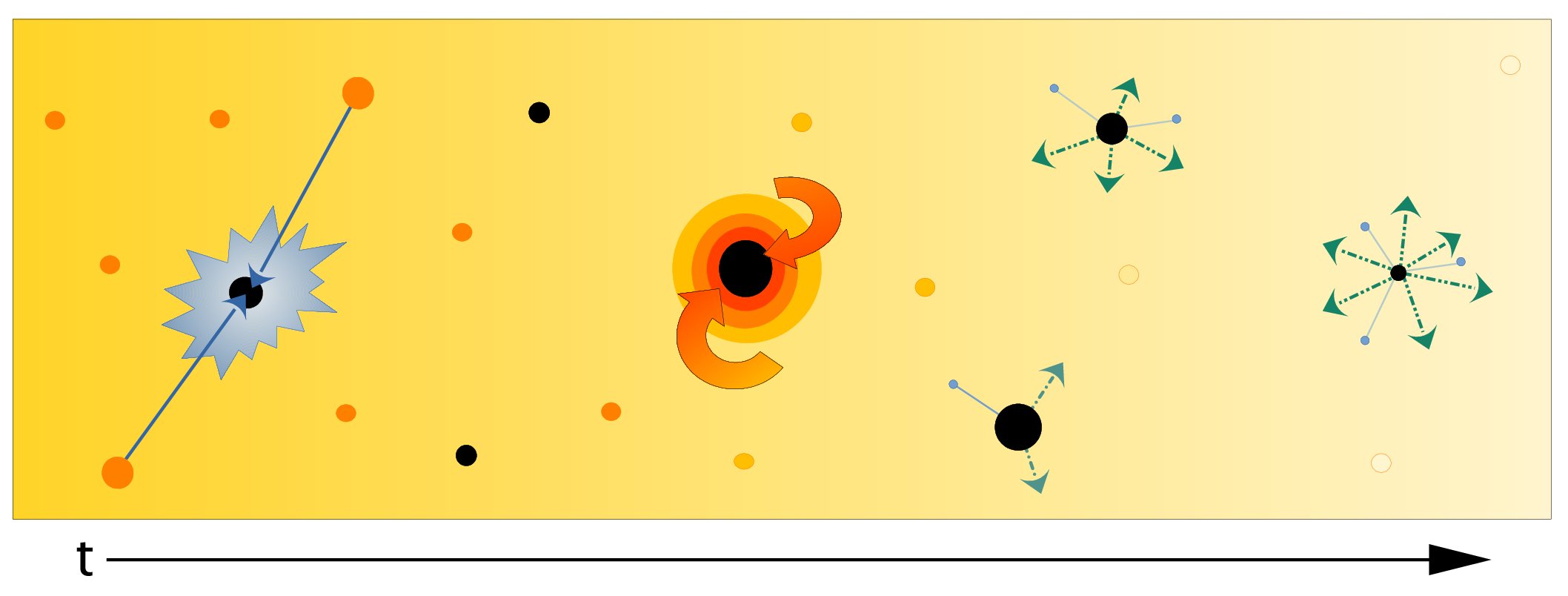
- An illustration of the life of extra-dimension black holes. Going from left to right: in the very early universe high-energy particles forming microscopic black holes. While the Universe is hot and dense, the black holes grows by consuming the surrounding matter. Finally, once the universe cools, the black holes stop growing and instead evaporate, potentially impacting its surroundings in ways that could observe today.
The main topic I have studied so far during my PhD is whether dark matter is made up of lots of extra-dimension black holes. All stars and other bright objects in the Universe that are made up of the particles we know and understand in the Standard Model of Particle Physics makes up only about 15% of the matter in the Universe. The other 85% of matter we generally know very little about and is called “dark matter”.
One proposal is that dark matter is made up of lots and lots of small (or not so small!) black holes dispersed throughout the Universe. If this were true one way we could detect them is from the black holes evaporating! As black holes evaporate, they produce lots of particles including photons (radio waves, visible light, x-rays, etc.) and electrons which could have an important impact on astrophysics.
Whether dark matter is made of black holes has been studied a lot but less often in the context of extra dimensions. Everything we experience in every day life is described in physics as 4-Dimensional (3 space dimensions plus time). To explain the hierarchy problem it was proposed that there may be extra dimensions. These dimensions would be very small so we don’t perceive them. Extra dimension black holes behave quite differently than regular black holes. They evaporate slower and evaporate into less energetic particles than regular black holes.
I worked with with Katie Mack, Sarah Schon, Ningqiang Song, and Aaron Vincent to study the creation and evaporation of extra-dimensional black holes and the resulting impact they would have on various stages of the Universe. By doing so we set upper bounds on how many extra-dimensional black holes could exist based on observations of the abundance of light nuclei formed in the early Universe, fluctuations in the Cosmic Microwave Background, and observations from X-ray and gamma ray telescopes. Beyond setting upper bounds we found that if there are two additional dimensions, the black holes produced would survive until today. In that case they might be what dark matter is made up of and there are currently no experiments that rule that possibility out!
Matter Anti-matter Asymmetry
The collection of the currently known laws and particles that exist in our Universe, the Standard Model of Particle Physics, has a symmetry between matter and anti-matter. This means that if the Standard Model completely described our Universe an equal amount of matter and anti-matter would have been created in the early Universe. If that had happened almost all of the matter in the Universe would have annihilated leaving a very boring world behind. The fact that we exist, along with stars and planets and all the structures we see, means that there must be some new physics not yet discovered which can explain why there is so much matter and so little anti-matter in the Universe today.
A popular proposal, called Electroweak Baryogenesis, is that during a phase transition in the very early Universe bubbles form and sphaleron interactions at the wall of the bubble can produce the observed asymmetry between matter and anti-matter. Whether this explanation works depends strongly on the dynamics of the bubble wall, specifically how fast the walls expand during the phase transition. During my masters, I improved calculations for the bubble wall speed demonstrating that in an extension of the Standard Model which includes an additional scalar field, the walls move sufficiently slowly such that the matter anti-matter asymmetry could be produced.
Publications
A. Friedlander, K. J. Mack, S. Schon, N. Song, and A. C. Vincent, Primordial black holes in the context of extra dimensions, Phys. Rev. D 105, 103509 (2022). arxiv:2201.11761.
B. Laurent, J. M. Cline, A. Friedlander, D-M. He, K. Kainulainen, and D. Tucker-Smith, Baryogenesis and gravity waves from a UV-completed electroweak phase transition, Phys. Rev. D 103, 123529 (2021). arxiv:2102.12490.
A. Friedlander, I. Banta, J. M. Cline, and D. Tucker-Smith, Wall speed and shape in singlet-assisted strong electroweak phase transitions, Phys. Rev. D 103, 055020 (2021). arxiv:2009.14295.
For an up-to-date list of my publication, see my Inspire-HEP page.
Talks
I have presented my reserach at a number of different conferences and seminars including
- August 2022 - Signatures of Primordial Black Holes in Theories of Large Extra Dimensions
- TeV Particle Astrophysics 2022 (TeVPA 2022)
- May 2022 - Signatures of Primordial Black Holes in Theories of Large Extra Dimensions
- Phenomenology 2022 Symposium (PHENO 2022)
- February 2022 - Primordial Black Hole Dark Matter in the Context of Extra Dimensions
- University of Sydney Video Here
- September 2021 - Signatures of Primordial Black Holes in Theories of Large Extra Dimensions
- Particles and Nuclei International Conference (PANIC2021)
- August 2021 - Signatures of Primordial Black Holes in Theories of Large Extra Dimensions
- Topics in Astroparticle and Underground Physics (TAUP2021) Video Here
- June 2021 - Signatures of Primordial Black Holes in Theories of Large Extra Dimensions
- Canadian Associatiion of Physicists Congress (CAP2021)
- November 2020 - Wall Speed and Shape in Singlet-Assisted in Strong Electroweak Phase Transitions
- Electroweak Phase Transition+ Seminar Series